- The Second Life
- Posts
- Desire Paths
Desire Paths
What urban architecture figured out about living someone else's life, that most people never do

benoit malige
April 07, 2026
You know the feeling I'm talking about.
Not the dramatic version.. not the breakdown, not the 3am crisis, not the moment everything falls apart. The quiet one. The one that shows up on a Tuesday when everything is technically fine: The job is stable, the relationship is fine, the apartment is nice, the plan is working.
And underneath all of it, something that won't go away.
It’s not exactly pain.. It’s more like a frequency you can't seem to shake off once you've noticed it. A low hum that says: this is not quite right. Not wrong enough to justify blowing everything up. But not loud enough to explain to anyone who asks. Just there. Persistent. Oddly specific.
You've been overriding it for years.
And the more successful you get at executing the plan, the louder it gets.
I want to tell you what that is. Because it took me an embarrassingly long time (and a lot of expensive real estate) to find out.
What a university campus taught me about the life you're not living
In the 1960s, the planners responsible for a major American university faced a problem every campus designer eventually faces: where do you put the sidewalks?
The conventional answer is: you design the campus, you decide where people should walk, you build the paths, and you enforce them. You are the architect after all. That is the job.
Well, these guys did something different. They built the buildings, planted the grass.. and..waited.
There were no sidewalks. No paths. No designated routes. Just people moving between buildings every day, making decisions in real time about where to walk.

After a full academic year, they looked at what the grass had done. Everywhere people had walked repeatedly, the grass had worn away. The dirt showed through. Lines had appeared: unplanned, unofficial, and almost always more direct and more logical than anything a planner working from a blueprint would have drawn.
They paved those lines.
The result is a campus that works because it was built from actual human behavior, not from a theory about it.

Urban planners have a name for those worn grass lines. They call them desire paths. And for over a century, the smartest designers in the world have been studying them, to understand what they're trying to say.
The desire path isn't a mistake. It isn't impatience or disrespect for the design. It's data. It's the accumulated evidence of where people actually need to go, as opposed to where someone decided they should.
Jane Jacobs (the woman who understood cities better than almost anyone in the 20th century) spent her career arguing against planners who designed for theory instead of reality. Her line was simple: "There is no logic that can be superimposed on the city. People make it, and it is to them that we must fit our plans."
The planners who fought desire paths spent decades losing. The ones who listened to them built things that lasted centuries.
Here is the thing that took me years to understand.
You have desire paths too.
And you've been replanting the grass over them your entire adult life.
Every desire path story is really a story about someone who kept walking the official route long after the grass was telling them something different. Mine just happened to span thirteen years and an entire country:
On May 12th, 2024, I wrote a breakup letter to America. I know how that sounds. Bear with me.

In 2011 I arrived in the US with a version of the American Dream I'd been constructing since 1993 (since my father brought our family to Poughkeepsie when I was a kid and I watched my classmates put their hands on their hearts every morning and believed, completely, that this place was where the real life happened).
By 2023 I had the real estate firm. I had the cars. I had the waterfront home. I was doing real numbers. From the outside, the plan was working perfectly.
I was also persistently miserable in a way I couldn't explain to anyone without sounding insane. Because what do you say — I have everything I wanted and I feel nothing? That's not a complaint you get to make out loud.
What I didn't understand yet was that it wasn't me running the company. It was a 14-year-old boy trying to prove something to his father. I was executing a program that had been written before I was old enough to vote, by a child who was hurt and angry and wanted to win. I had been so focused on following the plan that I had paved over every desire path that appeared and called it discipline.
In 2024 I let it all go. Started traveling. Started writing. Started, finally, walking the line that had been worn into the grass for years while I was busy maintaining the official route.
The short version: I spent 13 years building someone else's city, and wondered why I was miserable.
What your version looks like
Here is why I'm telling you this, and it's not because my story is particularly unique.
It's because yours probably has the same architecture and you might not have a name for it yet.
The desire path in your life doesn't announce itself as a desire path. It announces itself as the thing you keep doing instead of what you're supposed to be doing. The project you can't stop thinking about. The conversation you keep having. The version of your life you sketch out in your head on long flights and then close like a tab when you land.
It shows up as the thing your family has a polite name for. You've always been restless. You get bored easily. You're never satisfied. The impatience they've been diagnosing since childhood was in fact a desire path they kept asking you to get off.
The worn line in the grass doesn't come with a job title or an answer that makes sense at a dinner party. So you override it. You replant the grass. You build a fence. You tell yourself that real adults follow the designed route, that the instinct is a distraction, that you'll get back to it when things settle down.
The problem is..Things don't settle down. The hum gets louder.
And the painful part is that the more competent you are, the better you get at executing the wrong plan.
Intelligence is not protection against this. It is, if anything, the thing that makes it worse. Smart people are excellent at building elaborate justifications for why the official path is the right one. We are very good at making the fence look reasonable.
The desire path shows up. You feel it. And then your brain, the one you've spent years trusting, builds a case against it. It calls it avoidance. It calls it fantasy. It finds three rational reasons why the worn line in the grass is actually just fear dressed up as instinct. And because you're smart, the case is airtight. You convince yourself completely.
Then you wonder why the hum won't go away.
Why you can't see it clearly from the inside
The university planners couldn't design the right paths from their office because the information they needed didn't exist until people started moving.
Your desire path works the same way. You cannot think your way to it. You cannot plan your way to it. You cannot vision-board your way to it.
You can only find it by looking honestly at where you already go.
Not where you intend to go. Not where you think you should go. Where you actually go when the schedule falls apart, when nobody's watching, when you have a free afternoon and no obligations. Where does your attention walk? What do you keep returning to without meaning to?
That’s the data we’re after.
-
Speaking of Data, Two days ago I posted a video about identity.
The idea was simple: intelligence is optimized for understanding, not embodiment. That awareness without embodiment is just sophisticated suffering. That smart people can name every pattern running their life and still wake up living the same one.
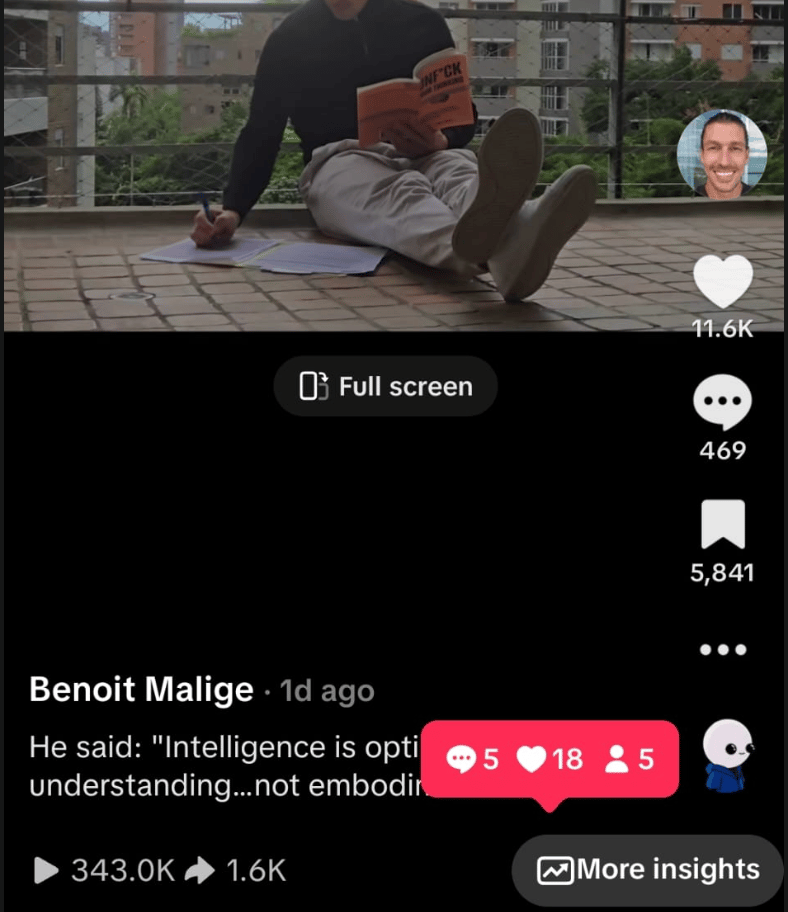
In 48 hours, 343,000 people stopped scrolling. 469 people cared enough to comment. 1,600 shared it. Nearly 6,000 saved it for later.
People wanted to go further. They wanted to know exactly how misaligned they were. Where the gap actually lived. What pattern was running the show underneath everything they already understood about themselves.
So I built a diagnosis. 180 people took it at the time I am writing this.
What came back confirmed something I had suspected for a long time: I am not the only one who spent years walking someone else's path. Not even close.
Here are some of the preliminary numbers. And they are, honestly, alarming.
Average misalignment score: 72%.
Most of these people are not in crisis. They are functional. Self-aware. Many of them successful by every external measure. And 72% of their life is pointed somewhere other than where they actually want to go.
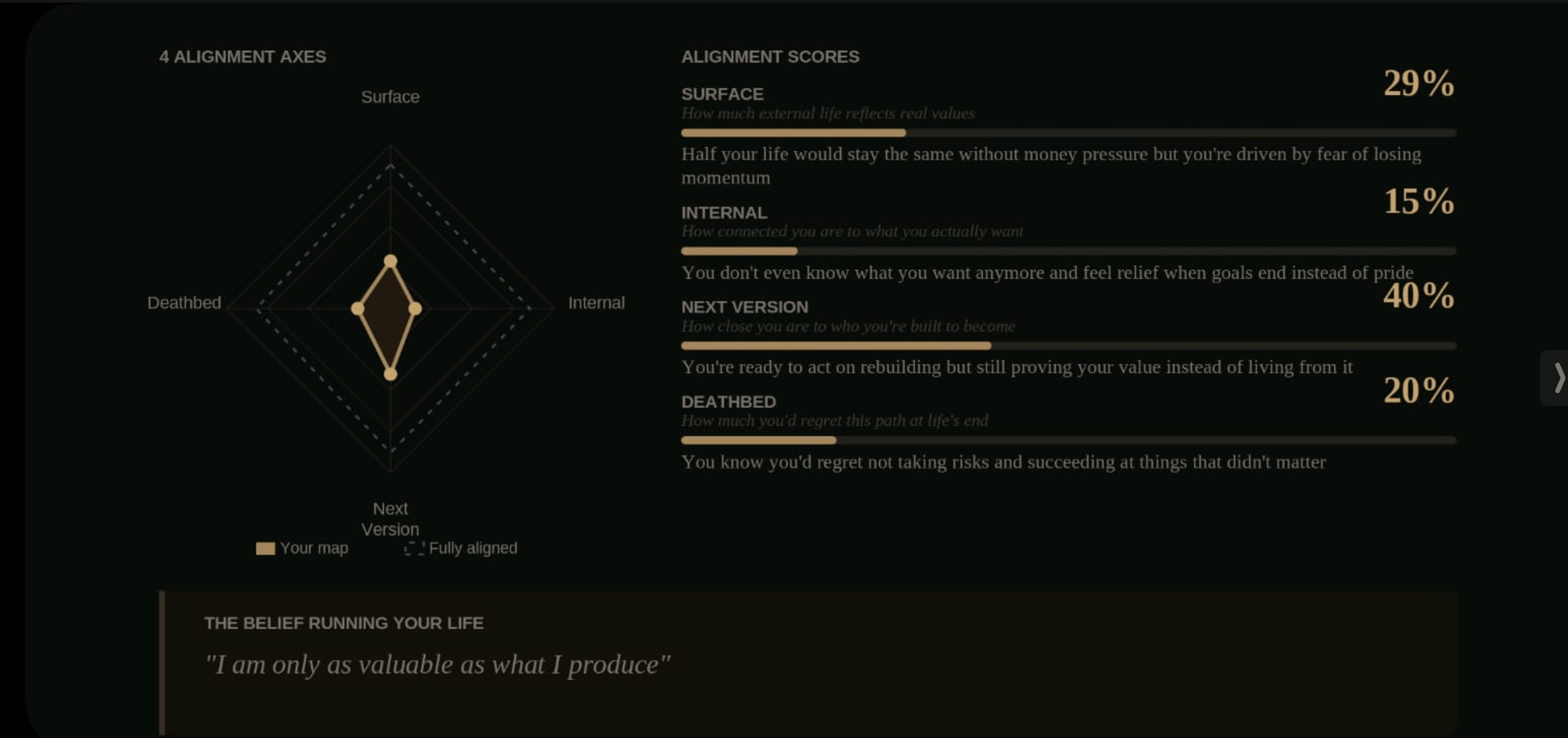
This is what one of those diagnoses looks like. I've kept the personal details private. But this line (from a real person, written honestly, without filtering) I want you to read it:

"I don't even know what I want anymore. I just keep moving."
If you want to see your own number (the one that's been running quietly underneath everything you already understand about yourself), the diagnosis is here:
-
Most people only see their desire paths ten years later, with the clarity of distance. You can see every place you paved over it. You can see what you were actually trying to walk toward the whole time.
You don't have to wait that long. But you do have to look.
Your second life
Here is what I know now, from the other side of the demolition:
The years you spent on the wrong path were not wasted. I know that's what it feels like. It felt that way to me. But the skills you built following someone else's plan are exactly what the right path needs you to bring. You don't get to skip that part. The university planners needed a full year of foot traffic before they could see the lines. You needed the years you had.
You are not behind. You did not miss your window.
You are, if you're reading this and feeling that frequency, exactly at the moment the grass has worn down enough to see clearly where you've actually been walking.
The desire path was never missing. It was just covered by a very well-maintained lawn.
There is a version of your life that was not designed for you by someone else. Not constructed from childhood wounds or parental expectations or the particular dream that happened to be on TV in 1993. A version built from where you actually go, what you actually return to, who you actually are when nobody's grading you.
I call it your Second Life.
And the Second Life is not created. It is revealed, then architected.
Stay smart,
Benoit