- The Second Life
- Posts
- Scar Tissue
Scar Tissue

benoit malige
April 17, 2026
You know the regret of not trying.
The potential partner you didn’t talk to. The hand you didn't raise. The risk you watched someone else take while you stood there doing math in your head.
Yeah. That one. We all have it.
And look..fear gets the blame. It's almost comfortable at this point. “Wasn't really me, I just wasn't ready, next time”. You close the tab and you move on.
I spoke about this at length, I wrote a whole book about it. But that’s not why we’re here today.
There's another one, and it’s going to require you to focus a bit, ok?
“What other one?”, you might ask.
Well..the one where you said no on purpose. You were there. Fully there. Nothing was stopping you except you, and you decided. You had a reason. A real one. A valid one: Something that happened to you, something you learned, something you promised yourself you'd never do again.
And you honored it.
And it still sits with you.
And here's the thing about this one.. you can't close that tab. Because fear isn't in the room. You can't point at it. Can't say “I wasn't ready”, can't say “I froze”. You were the one holding the pen. You signed this contract yourself.
And this one my friend, haunts you differently. So..was it discipline? Or was it a decision made by a version of you that doesn't exist anymore?
Let me tell you what it’s not: It's not a character flaw. It's not even a bad decision necessarily. It's scar tissue. When something hurts you badly enough (a partnership that went wrong, a relationship that cost you, a risk that didn't pay off) something in you forms protection around it.
And that protection is smart. It works. It keeps you from making the same mistake twice.
The problem is it doesn't know when the wound could have already healed.
It just keeps restricting. Keeps guarding something that might not need guarding anymore. And because it was built from real pain, it feels like wisdom. It feels like you finally knowing better.
And well..sometimes it is. Sometimes it's just old tissue doing its job on a wound that closed years ago.
If this is too abstract..put on your lab coat. I'll be your experimental guinea pig for a few minutes.
I recently had something show up that broke one of my own rules. A rule I was proud of. One I wrote the day I burned my old life down.
And I had to figure out — in real time — whether holding it was integrity or whether it was just old tissue doing its job.
That's what we're going to work through together. But first..I need to give you the tool. Because without it, my story is just my story. With it, it becomes yours too.
Here's the tool.
Most people are running a decision-making system with a missing layer. They have values (vague, felt, mostly automatic). They have rules (specific, tactical, written from pain). And nothing in between to translate one into the other.
So when a rule gets challenged, there's no way to know if it's a threat or an invitation. The rule just feels like identity. And questioning it feels like betrayal.
That missing layer is called principles.
Here's the distinction, and it matters:
Values are discovered, not chosen. They're who you already are. You find out you have them when something violates them. You don't think your way to them; you feel it immediately when a line gets crossed. They don't change much. They don't need to. They're not a decision-making tool. They're more like bedrock.
Rules are tactical. Written from experience, usually from pain. "Work alone." "Never rely on anyone else for results." "Don't chase money over meaning." They're values trying to express themselves in real life. The problem is they get written at a specific moment in time, and then they calcify.
Principles are the missing layer. Chosen deliberately. Constructed. Your operating system for getting where you want to go and becoming who you want to be. They're more durable than rules because they're not situational. They're more actionable than values because they're specific enough to actually run a decision through.
The goal of having principles is simple: to be able to make 90% of your decisions without agonizing over them.
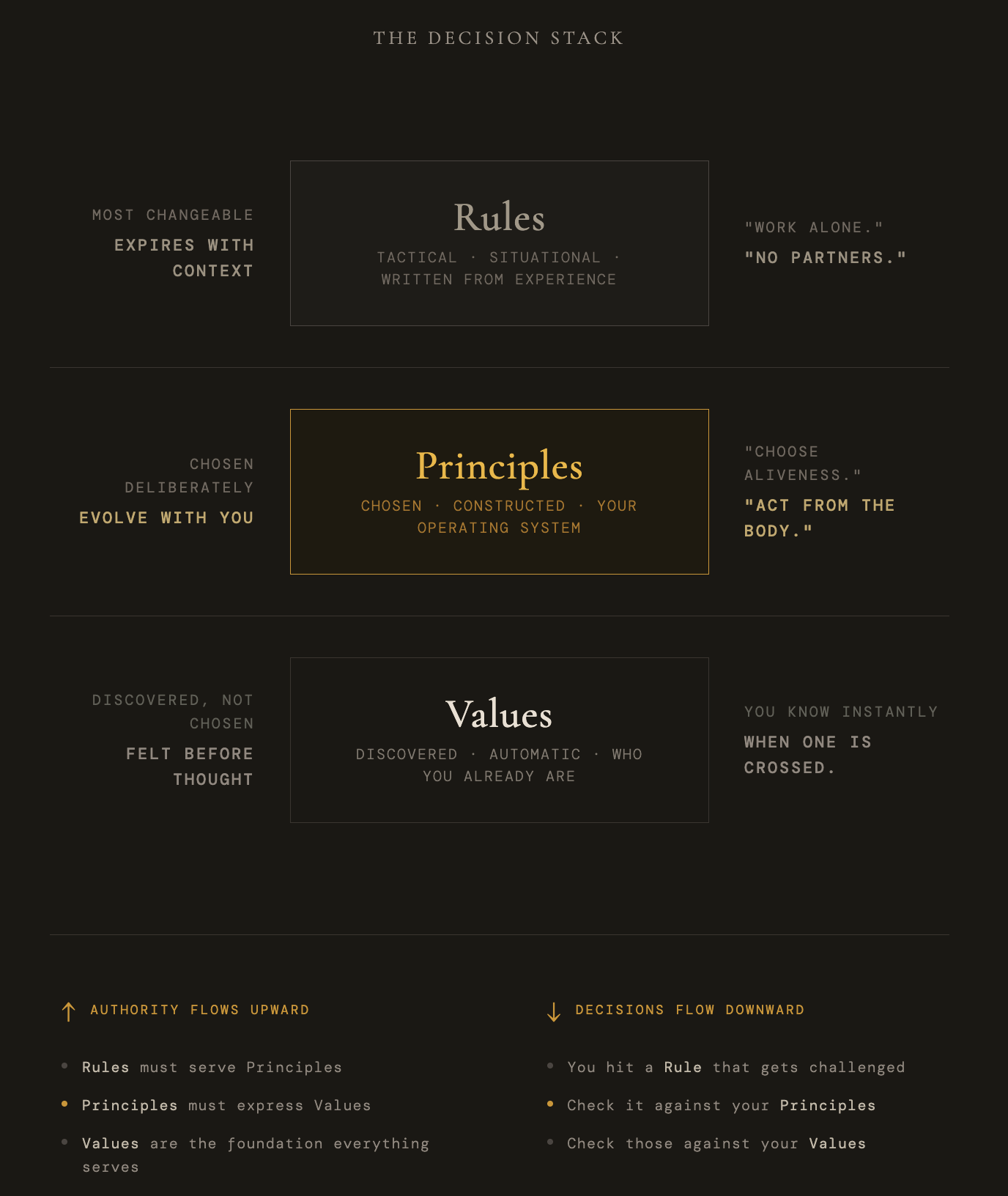
The flow works in two directions.
Authority runs upward: rules must serve principles, principles must express values.
Daily decisions run downward: you hit a rule, you check it against your principles, you check those against your values. If the rule still holds, you hold it. If it doesn't, you update it.
That's it. That's the whole system.
The problem most people have: they treat their rules like values. Unmovable. Identity-level. So when life asks them to reconsider a rule, they feel like a traitor.
They're not. They're just running outdated software.
Here are my 5. Copy at your own discretion.
I don't lead with values. I lead with principles.
Values matter. They really do. But values alone are too abstract to make decisions from. "I value freedom" doesn't tell you what to do when an interesting opportunity asks you to give up some of it temporarily. Principles do.
Here are mine. Five of them. I've tested these long enough that they've stopped changing much, which is how I know they're close to right.
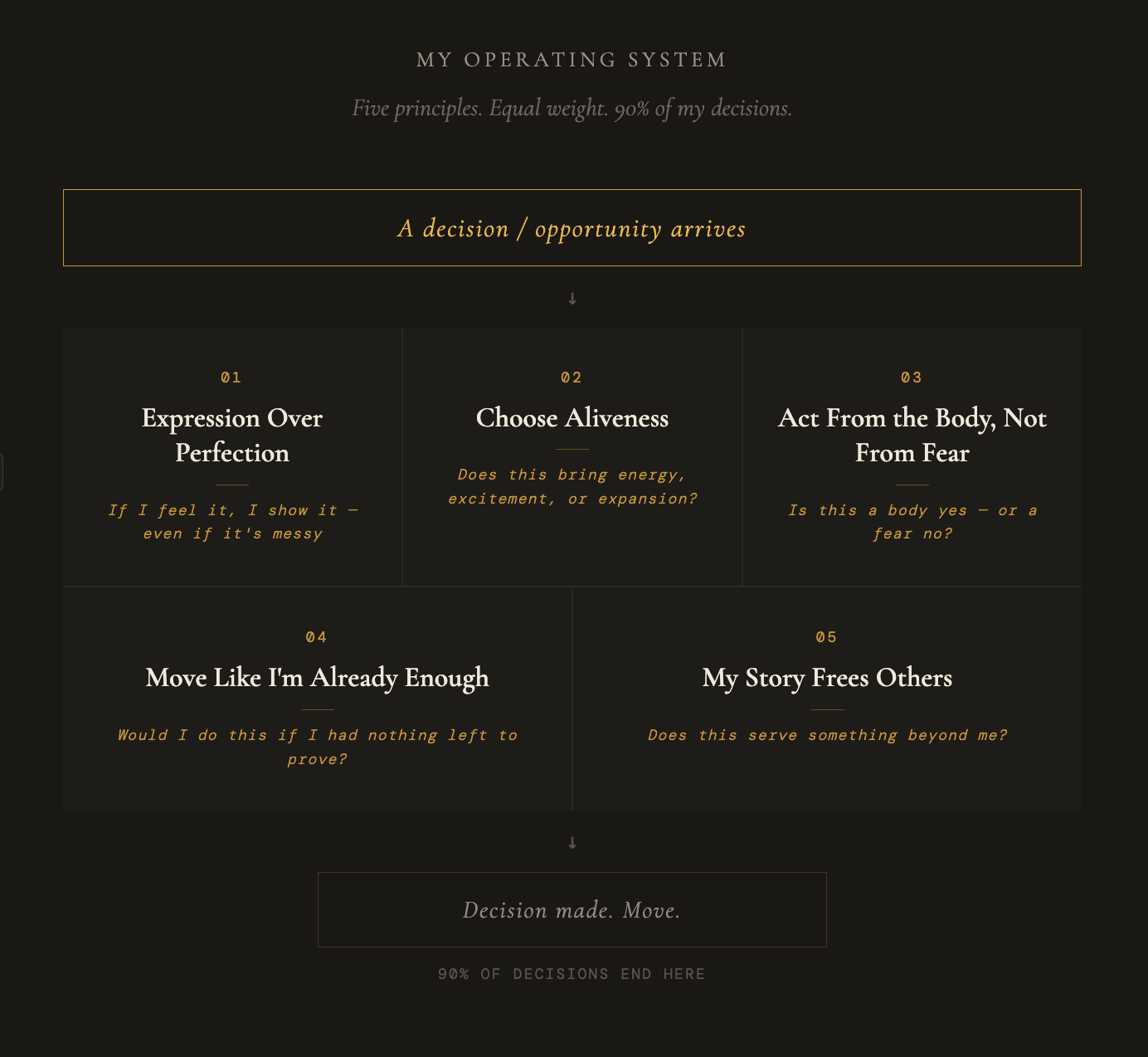
1. Expression Over Perfection If I feel it, I show it. Even if it's messy.
I used to edit everything to death. Rewrite until the life was gone. Publish nothing. Call it standards. This principle exists because I realized I'd rather be rough and real than polished and invisible. The cost is occasionally sounding like an idiot. I can live with that. (Fun fact, there are 2 grammatical errors in my published book that have been pointed out by readers, and for which I have deliberately left).
2. Choose Aliveness If it brings energy, excitement, or expansion. That's the direction.
Not a green light to chase every shiny object. I've done that. It's exhausting and expensive. This one is specifically for the moments when fear shows up and tries to convince me that shrinking is strategic. When I notice myself getting smaller around a decision, this principle asks one question: is this discernment or is this you being a little b*tch coward again? Usually I already know the answer.
3. Act From the Body, Not From Fear My truth lives in sensation, not in my head.
My head is a liar. Brilliant, fast, incredibly convincing. Frequently wrong. It will build an airtight case for whatever the fear wants and present it as logic (Oh.. and yeah, feed my ego of course). The body is harder to bullshit. There's a specific feeling that shows up when something is right. I've learned to trust that before I trust anything my brain wrote at 2am.
4. Move Like I'm Already Enough Worth is not earned or proven. It's lived.
This one exists because I spent thirteen years making decisions that were secretly about proving something to people who weren't even watching. The cars. The buildings. The whole performance. This principle cuts through every decision that has a hidden audience (This includes the 14 y/o version of myself). The question isn't will this make me look successful. It's would I do this if there was no one to impress. If the answer is no, I don't do it.
5. My Story Frees Others Honesty is my impact. Expression is service.
The uncomfortable thing. The unresolved thing (like this newsletter). The story I'm writing from inside instead of after. Every time I've published something I wasn't sure I should publish, this is the one that made me do it. And every time, without fail, someone writes back to say it freed something in them. So this one isn't generosity. It's just paying attention to what actually works.
-
These five run probably 90% of my decisions.
That's the goal. You iterate on your principles until they become automatic. Then they do the same work your values do, felt before thought.
The difference is you chose them. You built them toward something. That's not who you are by default. That's who you decided to become.
The live-through. A real decision, in real time
Someone brought me an idea recently. Interesting. Genuinely. I felt it.
And then something in me just.. closed. Before I'd even finished listening. An internal wall went up so fast I almost missed it. My head said no. Clean, quick, pretty much automatic.
I went home, and slept on it.
Woke up the next morning and it was still there. Just sitting at the edge of my thinking, like a browser tab I kept not closing. So I made the “mistake” of opening it again.
Half a day later I'd built a full business plan for it. That's when I knew something was off. Not with the idea.. with the no.
Because here's what I've learned about myself: when something won't leave me alone after I've already decided against it, it usually means the decision wasn't actually evaluated. It was just defended. The rule showed up, threw its weight around, and I called that discernment.
This time I caught it.
The rule is simple: work alone. No partners. No relying on anyone else for my results. I wrote that one in 2023, the day I walked away from a business where other people's performance determined my income, my stress, and pretty much my health. Valid rule. Still true in many ways.
But here's what I asked myself this time, instead of just obeying it: What Value is this rule actually protecting?
Autonomy and freedom: Not being hostage to someone else's follow-through. That's the real thing underneath.
Then the only question that matters: does this opportunity threaten that.. or does it just threaten the rule?
I ran it through my principles. Principle three is where something clicked: Act From the Body, Not From Fear. And the body had been saying yes since the first conversation.
Which meant the no was coming from the scar. Not from the principle.
So now I have an actual choice. Not whether to break the rule; that's the wrong question. Whether to update it, in a way that still protects what it was built to protect. And that means being ruthlessly clear with the potential partner about what autonomy looks like for me. What I will and won't compromise on.
That conversation hasn't happened yet.
I haven't fully decided yet. That's the honest answer. I'm still inside it. But I know now that the decision isn't "should I break my rule." It's "is this the right moment to update it", and I have a framework that tells me how to find out.
I'm writing this from inside it.
How to run this yourself
When a rule you've set for yourself gets challenged, here's the process:
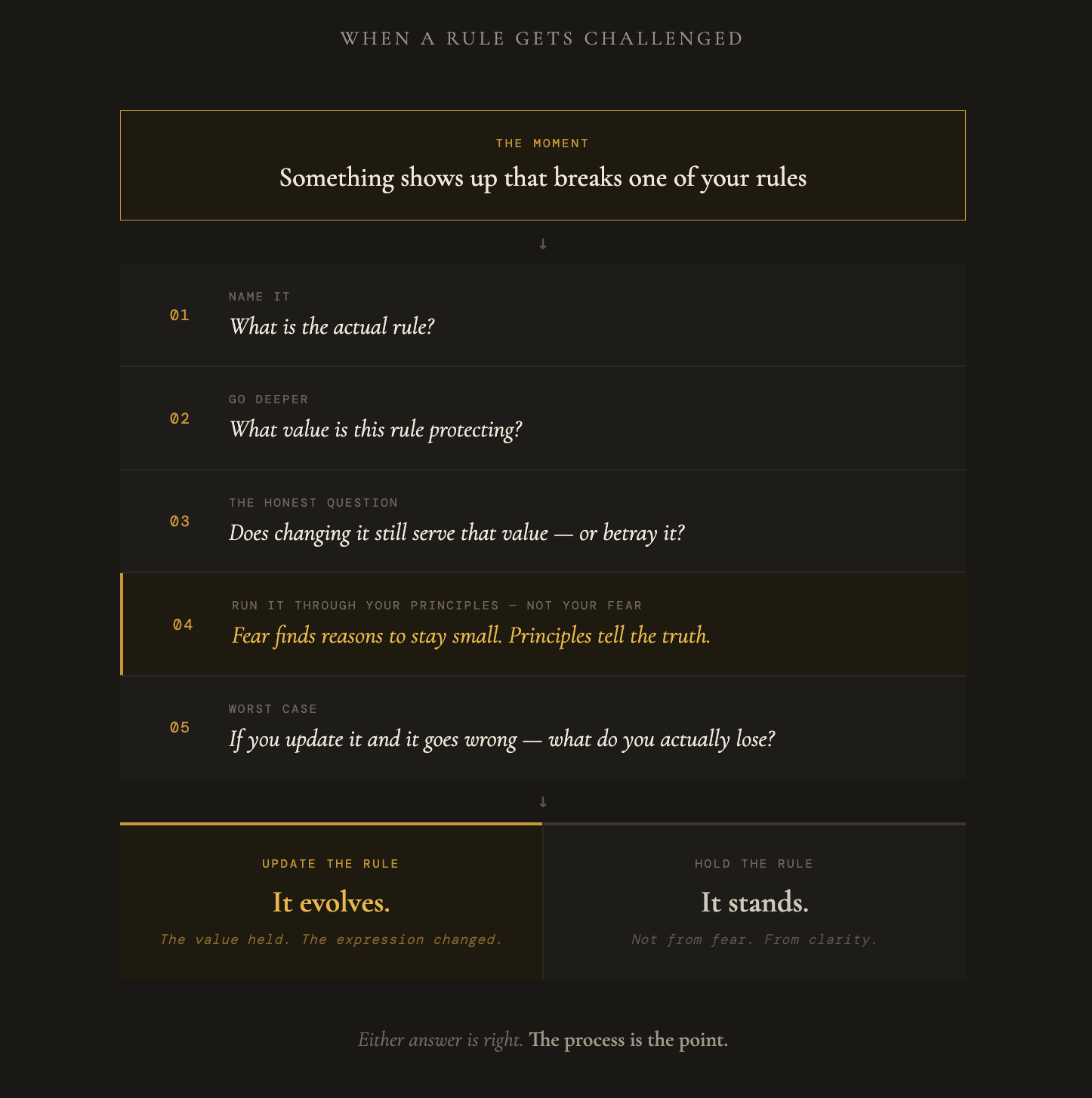
1. Name the rule clearly. Not the feeling. The actual rule. "I don't do X." Write it down if you have to. Vague rules produce vague decisions.
2. Find the value underneath it. What was this rule built to protect? Go one layer deeper than the rule itself. The rule is the expression. What's the thing it was expressing?
3. Ask whether updating the rule still serves that value, or betrays it. This is the only question that matters. Not "have I changed enough to break this rule?" Not "is the opportunity good enough?" Does changing the rule protect the same thing the rule was protecting — just in a different form?
4. Run it through your principles, not your fear. Fear will always find a reason to stay small. It will call rigidity wisdom and call contraction discernment. Your principles, if they're honest, will tell you the difference. If you don't have principles yet — this is the moment to notice that gap.
5. Run the worst-case scenario test. If you update the rule and it goes wrong, what do you actually lose? Not what your fear says you lose. What you actually, concretely lose. If the answer is less than what you'd lose by never trying, you have your answer.
-
If this piece made you realize your rules might be outdated scar tissue, or that your whole operating system needs a deeper rebuild, take the free Identity Diagnosis.
It takes 3 minutes. You’ll get your exact misalignment score and the belief that’s quietly running the show.
Final thoughts.
Here's what I want to leave you with.
You already know that some of your beliefs need updating. The ones you inherited. The ones installed before you had a say. You've probably done some of that work already.
But there's a subtler version of the same trap.
The rules you wrote yourself. In your second life. With full awareness. Built from real experience and real pain. Those ones feel different, because you chose them. Which makes them feel more like identity. More like something you'd be betraying if you let them evolve.
You wouldn't be.
Scar tissue is the body doing its job. But a body that never lets old tissue soften and adapt isn't healing. It's just protecting a wound that closed years ago.
Your operating system is allowed to update. Your principles can evolve. Your rules can be rewritten.
That's not inconsistency. That's the second life actually working properly and honestly.
The only question worth asking when a rule gets challenged is the one we worked through today: is this still protecting something real, or is it just old tissue doing its job?
If you can answer that honestly, you can move. In either direction. With clarity instead of guilt.
Maybe your version looks like this: do I take on a partner or stay solo. Do I pivot the offer or keep building what's not quite working. Do I finally charge what I'm worth or keep underpricing to stay comfortable. Do I trust this person or is that just the old wound talking. Do I say yes to the thing that scares me, or is the fear actually right this time.
Same question underneath all of it. Is this a real no.. or just old tissue doing its job.
Stay smart,
Benoit
-
P.S. Something I'm doing for the first time. This newsletter is about updating rules that have served their time. Here's mine: I've always kept my time offline. Private. I'm updating that rule.
A small, specific group. Small because this work is personal. Specific because when everyone in the room is already doing the work (already guiding others, already holding the mirror, already deep in this territory professionally) the answers compound in a way they can't anywhere else.
Six weeks. Bi-weekly live. You bring what's actually sitting on your desk. The real decision. The pattern that won't move. The version of yourself you keep almost becoming.
No frameworks. No content. Just the work, with someone who finds the thing underneath the thing, usually faster than you'd expect.
This is for the person who knows how to do this for everyone else. And has never had it done for them. If something in this piece landed, reply CIRCLE. I'll reach out personally before anything else.