- The Second Life
- Posts
- The Counterintuitive Law of Success: Focus on What You Hate.
The Counterintuitive Law of Success: Focus on What You Hate.

benoit malige
December 03, 2025
Everywhere you look, people talk about focusing on what you love.
“Follow your passion.”
“Do what lights you up.”
“Move toward joy.”
Great advice..Except when it isn’t.
Because there’s something far more powerful, especially for people who overthink:
You need to focus on what you hate.
And not in a subtle way.
In a brutally honest, write-it-down-on-paper kind of way.
This is a concept form Chapter 7 of The Manuscript, that I applied in every area of my life..except for one.
I’ll explain what happened in a second, but first, here’s why this matters to you:
Your brain burns more energy avoiding what you hate than pursuing what you want.
When you identify and remove the patterns that exhaust you (the fake effort, the forced behaviors, the roles you’ve outgrown), your mind suddenly frees up bandwidth.
Clarity returns.
Creativity increases.
Your decisions get sharper.
Momentum becomes natural instead of forced.
This isn’t just emotional advice.
It’s neuroscience.
Your brain cannot enter high-performance mode (the Direct Experience Network)
when you keep feeding the Default Mode Network with behaviors you resent.
Here’s something most people never realize: your brain works twice as hard avoiding the things you hate as it does chasing the things you want.
It’s incredibly efficient at it too. Over decades, it builds these small avoidance reflexes: tiny, silent flinches that get baked into your decisions without you noticing. And because they’re invisible, you never question them. You just call it “fatigue,” “lack of motivation,” “creative block,” or the classic: “I don’t know what I want.”
But you actually do know.
You’ve always known.
You just haven’t admitted the other half of the equation.
You are probably trying to build their life by asking:
“What do I love?”
But the question that actually gives you direction is:
“What can I no longer tolerate?”
The Hate list forces you to confront the things your brain tries the hardest to hide..because acknowledging them would require you to change something.
And change threatens the emotional comfort of the Default Mode Network.
That’s why we avoid it.
That’s why we overthink.
That’s why we spiral.
It’s not fear of the unknown, it’s fear of admitting the known.
The point is, once you eliminate what drains you, what energizes you becomes obvious.
Which brings me to the part I didn’t expect.
I realized (only recently) that there was one place I never applied the Hate List.
I used it to rebuild my life. I used it to leave a business that no longer fit me. I used it to design one of the philosophies behind the book.
And somehow, my brilliant self never thought to apply it to the thing I was doing almost every day: the way I express ideas online.
I had an entire chapter explaining why clarity comes from subtraction, and yet I never asked myself the most obvious question: “What do I actually hate about creating?”
And when I finally did, the answers punched me in the face.
I hated scripts.
I hated sounding like a polished cardboard version of myself.
I hated shrinking big ideas into small formats.
I hated performing.
I hated pretending to be an “expert” when all I really want to do is learn and explain.
So I grabbed my old manuscript (the one that eventually became the book) and opened the chapter on the Hate List.
There it was.
Black ink.
Clear logic.
The exact advice I had ignored:
“You don’t build clarity by adding more. You build it by removing what kills you.”
So I removed everything I hated.
No more scripts.
No more pressure to sound smart.
No more “creator voice.”
No more pretending my brain works in 7-second clips.
Just me, my thoughts, and the rhythm that feels natural to me.
And here’s the embarrassing part:
The shift was instant. In one week, just on one platform:
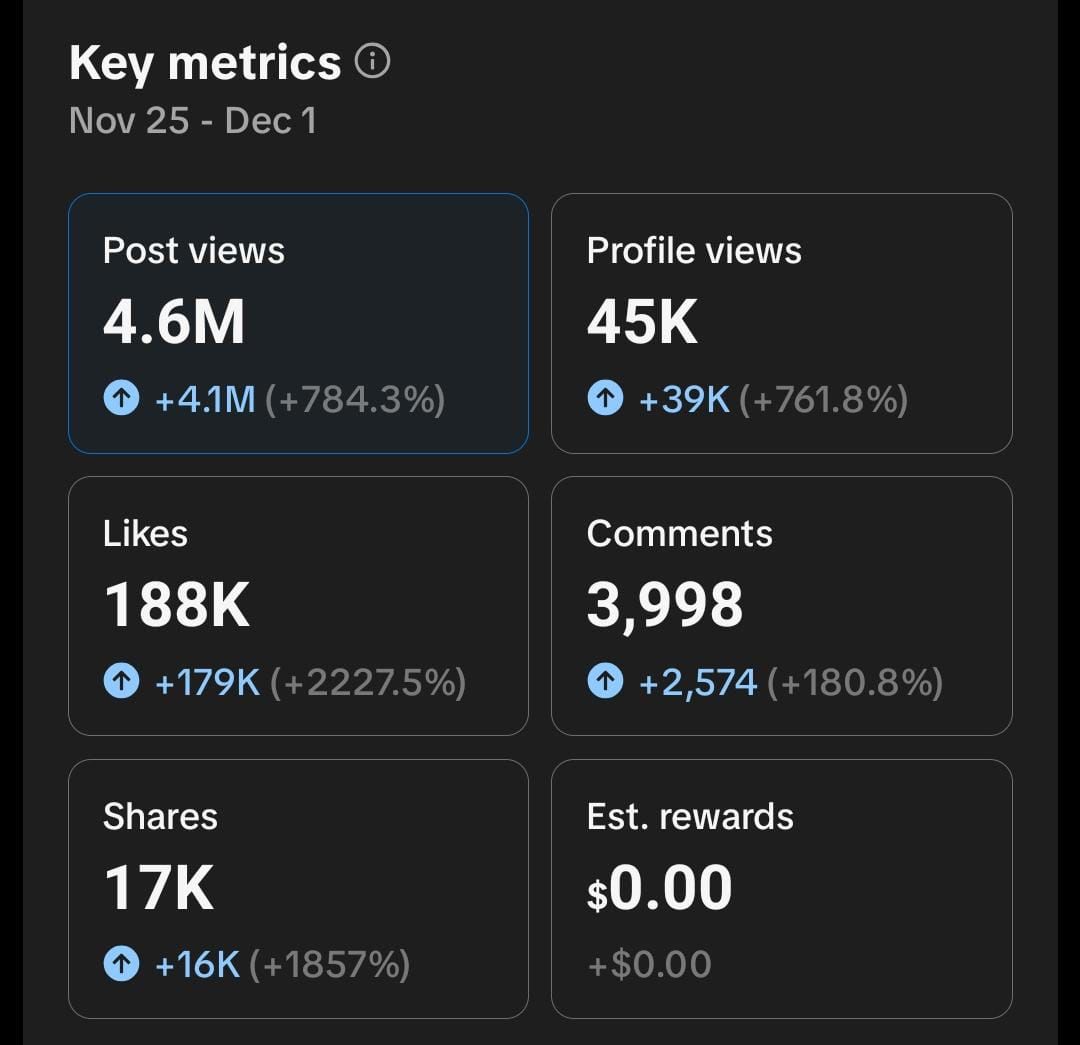
When you stop creating from misalignment, your brain stops wasting resources trying to protect you. Your attention sharpens. Your energy returns.
It wasn’t strategy.
It wasn’t optimization.
It wasn’t genius.
It was a simple question of subtraction.
The same thing I’ve been teaching for two years, applied to a place I never thought to apply before.
The reason I am sharing this is because what’s more important than ever is no the numbers, it’s the principle:
Misalignment is expensive in every part of your life. And the moment you remove it, everything else opens up.
Clarity shows up when friction leaves.
Momentum appears when resistance disappears.
Purpose grows when misalignment stops hijacking your attention.
And the most ironic part?
The life you want is on the other side of one honest list.
Write it.
Even if it scares you.
Especially if it scares you.
Until next time,
Benoit

PS: What’s one thing you already know you need to remove, but keep pretending “isn’t that bad”? Hit reply. I read these.