- The Second Life
- Posts
- The Hidden Messages in Everyday Friction
The Hidden Messages in Everyday Friction
And why most people misread them.

benoit malige
March 19, 2026
Triggers. They happen. To you, to me.
What was the last thing that triggered you?
Was it someone cutting you off in traffic? A comment that landed wrong? Someone taking credit for something that was yours?
For me, it was last week. You'll probably think I'm an asshole, but here it goes.
I was sitting at a small restaurant in Medellín. Good food, candles on the table, the kind of place where you ask for recommendations or you end up ordering a burger out of decision fatigue. So I asked.
The server leaned in and said: "I have the arepas de chócolo with hogao, and I have the bandeja paisa if you're hungry."
I think my left eye twitched.
You don't have it. The restaurant has it.
I caught it almost as fast as it appeared. This tiny, completely ridiculous friction (a man doing his job well) and my brain had already filed an ocular complaint.
But then another thought arrived right behind it.
Wait. Maybe he's right. Maybe speaking as if the experience belongs to you is actually a better way to move through the world. Maybe that's not arrogance. That's ownership.
And then, because I can't help myself: maybe I lack ownership in the things I talk about. Maybe that's exactly why this triggered me. I'm seeing a gap in myself and projecting it onto a guy describing rice and beans.
So which was it? Was that reaction about him? Or about me?
I sat with that question for the rest of the meal.
-
Same afternoon. Completely unrelated. A friend texts me to say hi. I wish I could saw we talked about the weather.
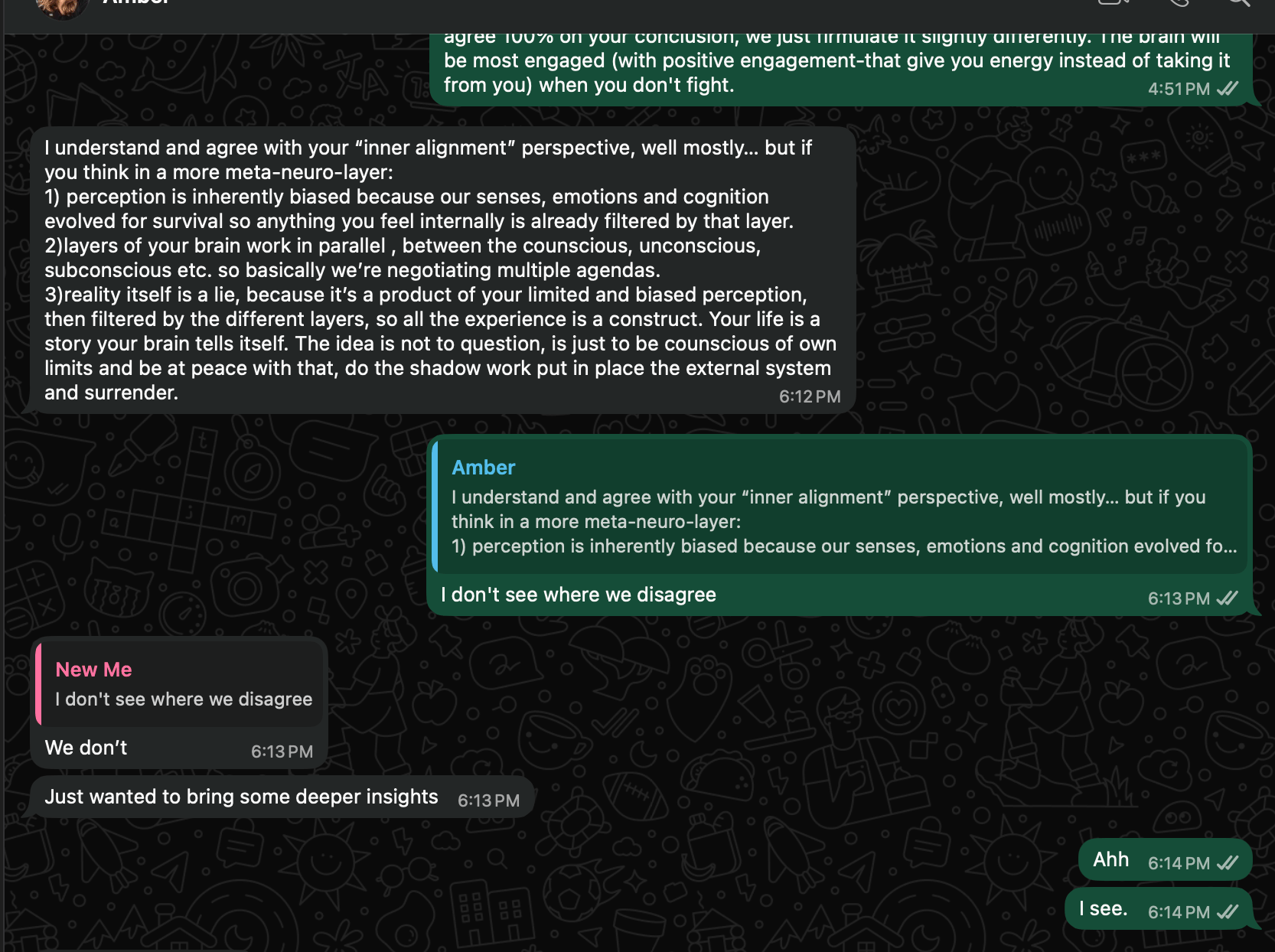
She went deeper into what I’d said, added layers, and expanded the idea.
My immediate read: she's not agreeing with me.
Slight tension. Defensiveness. The impulse to hold my ground.
She clarified: we don't disagree. She was just going deeper.
“Ahh. I see”.
That "Ahh" cost me something to type. Because it meant I'd spent twenty seconds in a defensive posture over nothing. She was expanding my idea and I read it as a threat to it.
Two triggers. Same afternoon. Same nervous system.
But they weren't the same thing at all.
That question followed me out of the restaurant.
A coach I respect open my eyes last year: when a trigger hits, lean in. Your ego is waving a flag at something worth seeing.
I've used that idea for over a year. It's good. It works. I’ve taught it.
But I turned it into a rule. Every trigger became a session. Every moment of friction got dissected until I found the lesson buried inside.
At some point, the examination becomes its own trap. I even wrote about this, the way over-intellectualizing gets you nowhere. The fine line between useful self-reflection and living permanently inside your own head.
Here's what I've been sitting with: not all triggers are the same kind of message.
Some show you something about yourself worth examining. The text exchange was that. Why did I feel the need to defend something that wasn't under attack? That question had something real in it.
Some reveal a value, not a wound. Something bothers you because it violates something you actually believe in. That's just information about who you are; not necessarily a flaw.
Some are your brain noticing a pattern and flagging it before it knows what's actually happening. The server, maybe. My brain flagged unusual language. Nothing to fix. Just how I'm wired.
And some (the most interesting ones) are your brain inventing a story before the facts are in. The text exchange again, at first. I read disagreement into an act of intellectual generosity.
The question isn't whether to pay attention. It's whether what you're feeling is asking something of you, or just running a pattern on incomplete data.
-
Four months ago in Tulum I ran a small experiment.
For one week I decided to operate from an open heart by default. Assume good intentions. Assume curiosity. Assume people mean well unless shown otherwise.
It became one of the most interesting weeks I've had in my life.
Nothing external changed. Same people. Same world.
But when your heart is open, information arrives differently. Neuroscientifically, you're operating from your direct experience network: present, engaged, alive to what's actually happening, rather than your default mode network, which is running simulations, protecting the past, anticipating threats that may not exist.
An open heart isn't naive. It's just a different filter on the same reality.
And from that state, most triggers don't land the same way. The server's "I have the chicken" doesn't file a complaint. It registers as a man who takes ownership of his work. And you move on.
-
Which leads to the biggest realization.
When your nervous system is in that state (safe, open, present), it doesn't eliminate triggers. It filters them. The noise disappears. What remains are the ones that actually matter.
Which means triggers aren't just information about the moment. They're information about your nervous system. When you keep getting snagged by things that shouldn't matter, that's not a sign you have more work to do on your triggers. It's a sign your nervous system needs recalibrating.
And this doesn’t just show up in your personal life. It shows up professionally too..often with triple the consequences.
A business owner running the Protocol sent me a message recently.
He'd written down what he refused to keep tolerating. Specifically, a recurring conversation that drained him every time it came up. Within the hour, he had to have that exact conversation.
He described what happened:
"When I started having the type of conversation I hated, I was very grounded and stayed in the pocket. I actually had a positive resolution where the other person thanked me. This made my day so positive, I was full of energy and feeling confident rather than feeling drained as usual."
That's not conflict resolution training. That's not a communication framework.
That's a nervous system that had been prepared. He went into that conversation without the fear state that would have normally activated. No defensive posture. No need to protect himself from an outcome he'd already decided to refuse.
He wasn't triggered because there was less inside him for it to catch on.
I wish I had known this when I was running my real estate business. Every difficult conversation, every negotiation, every moment where someone pushed back.. I operated from survival mode. Fear of the outcome. Fear of losing. The trigger would land and I'd either fight it or avoid it entirely. Neither worked particularly well.
I did the work after. That's why I'm here.
-
Which brings me back to triggers.
Two things I've learned this week that I think are worth keeping:
The first: not every trigger is asking something of you. Some are mirrors: they show you something real about yourself worth examining. Some are your values reacting to something that violates them. Some are your brain running pattern recognition on incomplete data and filing a complaint before it knows what actually happened.
The work is learning to tell the difference fast enough to come back to your life.
The second: the more you train your nervous system toward safety, the fewer triggers reach you at all, because there's less inside you for them to catch on. The ones that remain are the real ones. Worth examining every time.
The goal isn't zero triggers. It's a nervous system so recalibrated that only the meaningful ones make it through. I'm still practicing.
You probably are too.
Stay smart,
Benoit
-
If any of this resonates (if you're tired of the same triggers catching you in the same old ways) the tools that finally moved the needle for me are in these two places:
The Double Entry Protocol is the system I built when I realized understanding my patterns wasn't enough to change them. The people running it right now: 7 and 8 figure entrepreneurs, coaches, therapists. If that's your world: You can close the gap here.
None of this would exist if I hadn't gotten out of my own head first. That's what Unf*ck Your Thinking is about. [Amazon] [PDF]