- The Second Life
- Posts
- Why Naps Don’t Rest Smart People

Naps are supposed to help.
I mean, that’s the rule, isn’t it? Close your eyes. Shut down for a bit. Wake up refreshed.
Except some of us don’t.
We wake up foggy, disoriented, slightly off. Like the brain never fully came back online.
For a long time, I assumed that meant something was wrong with me.
In fact, I did what most people do when something doesn’t work for them: I blamed the thing.
Looking back, that assumption probably traces back to a nap I took around 13, when I woke up at 7pm, convinced it was 7 AM. You see, my family played along with it, and let me get ready for school like nothing was wrong. This means I spent an uncomfortable amount of time functioning in a completely false reality.. which, as it turns out, is more than enough to wire a brain to associate sleep with disorientation.
Since naps always made me feel worse, I decided they were stupid. Weak. A luxury for people who couldn’t handle their day. Classic move. If you’re bad at something or don’t understand it, just pretend you don’t need it.
So I refused to nap for years. “Nah bro. I just don’t nap.” has been my typical answer. As if that said something impressive about me.
Fast forward to last week.
I had a dinner planned with someone. I wanted to be present and relaxed. A good version of myself to be around. So earlier that day, I figured I’d give naps another chance. You know… rest a bit, show up as a better human being.
Well, my good intentions backfired.
I walked into that dinner groggy, irritable, and negative. Zero patience with the waiter. Low tolerance for anything. I had quite literally transformed into a version of myself I’d confidently label a piece of shit.
I got called out. I later adjusted as best I could. Then later, lying in bed, I replayed the evening.
That’s when I had to get to the bottom of this. And so began my nap rabbit hole.
-
You see, the issue isn’t naps. It’s what happens when certain brains partially shut down, and then have to reboot in the middle of the day.
Some nervous systems don’t tolerate half-sleep well. They don’t transition cleanly. Instead of rest, you get disorientation. And instead of recovery, you get friction.
Bottom line: If naps worked for me, this would just be a story about a bad dinner.
But they don’t, and that’s the point of this letter.
Why naps don’t rest certain brains (like mine, and probably yours if you're reading this)
The problem isn’t that naps don’t help. It was that they reliably made things worse. For me, that immediately rules out the usual explanations:
If it were a sleep deficit, any rest should help.
If it were discipline, pushing through should work.
If it were laziness, coffee would fix it.
None of that is true. So once I stopped treating naps like “rest” and started treating them like a biological event, things became clearer very fast.
A nap isn’t recovery. A nap is a state transition:
Awake → asleep → awake again.
Conscious → unconscious → conscious.
And state transitions are risky moments for any system because things can come back online out of order.
Some brains do not tolerate being halfway anywhere. You see, for us overthinkers, the in-between state (not fully awake, not fully asleep) is quite destabilizing. Executive control goes offline, but self-monitoring stays active.
So instead of: down → recover → come back refreshed
You get: down → loss of orientation → confusion → hypervigilance
In other words, that’s the brain checking for danger. Which already explains a lot of the fog, the unease, and the irritability. But it still doesn't explain why this almost always happened in the afternoon.
Well, friends, that’s where cortisol comes in. Cortisol (on top of being a stress hormone), is an activation hormone. And it follows a predictable rhythm. There’s a natural dip earlier in the afternoon. Then cortisol starts rising again later, whether you like it or not. That rise is unavoidable.
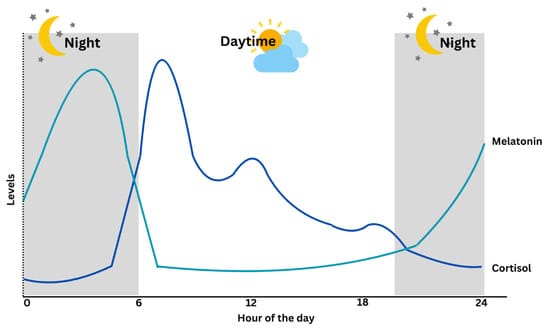
Typical circadian rhythms of cortisol (blue line) and melatonin (teal line). Cortisol peaks sharply after waking, declines through the day (with a natural dip in early-mid afternoon), then often shows a subtle rise in late afternoon before dropping to its lowest at night. Your nap timing hits right in/near that dip; but if it's too long or mistimed, you wake into the beginning of the rise = mismatched alertness + grogginess.
Now combine that with a state transition (the nap):
If you nap into that rise, your brain wakes up before your nervous system has fully downshifted. So you come back online with:
alert chemistry
reduced executive control
poor emotional regulation
In other words: awake, but not in charge yet. That’s the “brain hangover.” And for people who already run slightly higher baseline cortisol (overthinkers, perfectionists, and neurodivergent folks), this effect is amplified.
This means you’re chemically alert, cognitively foggy, and emotionally irritable. (Which is the perfect recipe for being an asshole to people you actually like).
Which is why a bad nap feels worse than no nap at all.
At this point, the diagnosis was clear.
The issue isn’t naps.
The issue is partial shutdown at the wrong point in the day.
Let’s define what we REALLY want out of a nap.
Because if we can name the benefits, we can design a version of “nap” that delivers them without the side effects. Here’s the suggested list:
a drop in nervous-system noise
a brief interruption of mental friction
a return to clarity
a mood reset
the feeling of “I’m back”, and better
Notice what’s not on the list: “being unconscious for 60 minutes.”
Sleep was never the goal. State change was.
So let’s redefine a nap as this:
A strategic state transition that uses the early afternoon downshift window to reduce stress signals without letting the brain fall into a deep shutdown that makes the reboot ugly.
That’s the whole game.
Which means the “best nap” for brains like mine and yours is not a nap in the traditional sense.. It’s more of a controlled downshift.
You take the dip in energy as your entry point, you let your system soften, you drop the noise, but you don’t cross the line into deep sleep.
Because the moment you do, you’re no longer resetting the system, you’re rolling the dice on how you come back (and we won’t like uncertainty here).
When you look at fields where waking up foggy is unacceptable (pilots, soldiers, high-stakes operators) you see the same pattern over and over: No naps or complete shutdowns. So that’s what this is.
And I’m coining it:
The Controlled Downshift Protocol.
1. Timing
Early afternoon. Ideally between 1 and 3 p.m.
This is the natural downshift window (before cortisol starts rising again later in the day).
Do not do this late afternoon. And do not do this in the evening You’re using the dip, not colliding with the rebound.
2. Duration
8 to 15 minutes. Hard stop before 20 minutes.
Set a timer. This is non-negotiable.
The moment you drift into deeper sleep, you lose control of the transition.
3. Position
Reclined or lying down, with legs slightly elevated. The point isn’t comfort, but mechanics.
Elevating the legs improves blood flow back to the heart and brain (improves venous return to the heart and brain, which helps downshift faster without deep sleep risk.) That alone reduces perceived effort and helps the nervous system downshift faster.
You’re lowering stress signals without pushing the brain toward deep sleep.
Plus, legs slightly up hits the sweet spot:
low effort
high safety
minimal chance of disappearing
Which is the whole point of this protocol.
4. Breathing
Slow, nasal breathing. Roughly 4–6 breaths per minute.
That pace does two things at once: it quietly lowers stress signaling by lengthening the exhale, and it gives the brain a simple, low-effort task to rest on so it doesn’t spiral.
You’re not trying to control your breathing or relax harder. Just letting the system settle while staying present. If breathing stays fast, the nervous system stays “on.” If it slows too much, you risk drifting into sleep. This range sits in the middle: calm enough to downshift, active enough to stay oriented.
5. Intention (this is critical)
No intention to sleep. You are resting while awake.
Quiet wakefulness preserves orientation, which is exactly what this protocol is protecting. We don’t want to go offline, remember?
6. Exit
When the timer ends, stand up.
Getting out of it is just as important as what you do during the rest. If you linger, scroll, or negotiate with yourself, you blur the transition and undo the reset you just earned.
So when the timer ends:
Stand up.
Move.
Stretch or walk for a minute.
That movement hands things back to the natural cortisol rise and locks the state in. You don’t “wake up.” You don’t ease back in. You just.. continue.
-
That’s the protocol. It’s simple, kind of boring, and repeatable. And notice that now you don’t ‘wake up’ from a nap anymore. You stand up.
Clearer.
More patient.
More like yourself.
-
Now to the actual point. (Wait, what?)
This letter was technically about naps…
but it was never really about naps.
And before you get angry and shout mutter “So why the f*ck did you have me sit through a 2,000-word essay about a 10-minute rest?”
Look. realistically, no one is forwarding this because of a revolutionary opinion on lying down at 2 p.m. But Why naps don’t rest smart people was never really about naps.
It was about what happens when a busy, intelligent brain keeps running into the same problem and does the usual thing: tries harder, judges itself, or powers through.
That’s what most smart people do. And it’s exactly why they stay stuck longer than they need to.
What I actually wanted to show you is the alternative:
Instead of ruminating, I gave my brain something useful to do.
Instead of asking “what’s wrong with me,” I asked “what’s actually happening?”
Instead of fighting the system, I looked at the constraints and designed around them.
For me, that’s the part that matters. Because this exact structure works pretty much everywhere:
When your energy crashes.
When motivation disappears.
When discipline stops working.
When your identity feels off but you can’t explain why.
The overall structure of this letter should give you a blueprint to solve problems:
Strip the assumptions → Look at the mechanics → Respect biology and reality instead of arguing with them → Then build a solution from the ground up.
And if you’re the kind of person this letter resonates with, chances are your brain isn’t the problem. It just needs better problems to work on.
If this way of thinking feels familiar, I break it down more explicitly in Chapter 8 of Unf*ck Your Thinking (Solving Problems Like a Mental Engineer), where I go deeper into how to turn mental noise into forward motion instead of self-interrogation.
As for naps? Now I don’t wake up foggy, tense, or quietly ruining evenings I was actually looking forward to.
And honestly, that’s a pretty good benchmark for most things in life.