- The Second Life
- Posts
- You’re Asking the Right Questions, in the Wrong Order
You’re Asking the Right Questions, in the Wrong Order
And it's keeping you stuck before you even start.

benoit malige
January 23, 2026
TL;DR
You’re stuck because you start with How.
Clarity doesn’t come from thinking; it comes from movement.
The correct order is:
Decide what you want to change
Anchor it to a why that carries weight
Let the RAS filter reality
Let the how reveal itself through action
What + Why (RAS) → How
This is the neuroscience of momentum.
-
You know what you want to change. You’ve known for a while. You just haven’t moved on it.
Your life works, and that’s part of the problem. Nothing is urgent enough to force your hand. Nothing is broken enough to demand action. So you stay functional, productive, and reasonable.
You think a lot..about
What you could build.
Who you could become.
What a different version of your life might look like if you made a few decisive moves.
You don’t lack ideas..you have too many. You read, listen, save, revisit decisions in new forms and call it refinement. It feels like progress because your mind stays busy, but nothing in your life actually changes. You're not avoiding work. You're avoiding exposure. And asking 'how' first is the perfect way to stay safe while feeling responsible
The question you keep asking is not wrong.
It’s just early.
“How?”
How do I start.
How do I make it work.
How do I avoid wasting time, money, energy, my reputation.
How do I make sure this doesn’t blow up in my face.
On paper, it sounds like intelligence. Like someone who has learned from past mistakes and doesn’t want to repeat them. You’re trying to do this the right way. That’s exactly why it works so well.
Because asking how does something very specific. It gives your brain a task without forcing your life to change. You get to stay seated while feeling engaged. You get to stay safe while feeling responsible. You get the emotional reward of effort without the risk of commitment.
You feel better after thinking it through. After imagining different scenarios and contingencies. Your nervous system relaxes a bit, and you tell yourself you’re making progress because your mind is busy.
But nothing moves.
When you start with how, you’re not solving a problem. You’re mostly managing uncertainty.
And uncertainty is the thing your brain hates most; so it feeds you more thinking. More planning. More hypothetical conversations and imaginary outcomes. Enough to feel productive but not enough to force a decision.
That’s why you can ask how for months. Sometimes years. And still be in the same place.
Because the problem isn’t knowledge. It’s that your mind keeps evolving while your life stays the same.
Nothing breaks, and that’s the trap: You just wake up one day and realize you’ve been preparing for a life you never started.
Conviction Comes Before Certainty
You will never know how things will actually work out.
Not in advance. Not cleanly or clearly. Not the way your brain wants. And waiting to know is exactly why nothing moves.
What you do know is simpler: If you don’t start, it definitely won’t work.
That’s the asymmetry I used to ignore. Action contains uncertainty, but inaction contains certainty. The certainty of staying where you are.
This is why conviction matters more than clarity.
Conviction is deciding that something matters enough to move without guarantees. That the cost of staying the same is higher than the cost of being wrong. That you’re willing to look stupid, inefficient, or early in exchange for momentum.
That’s why this is the sequence that matters:
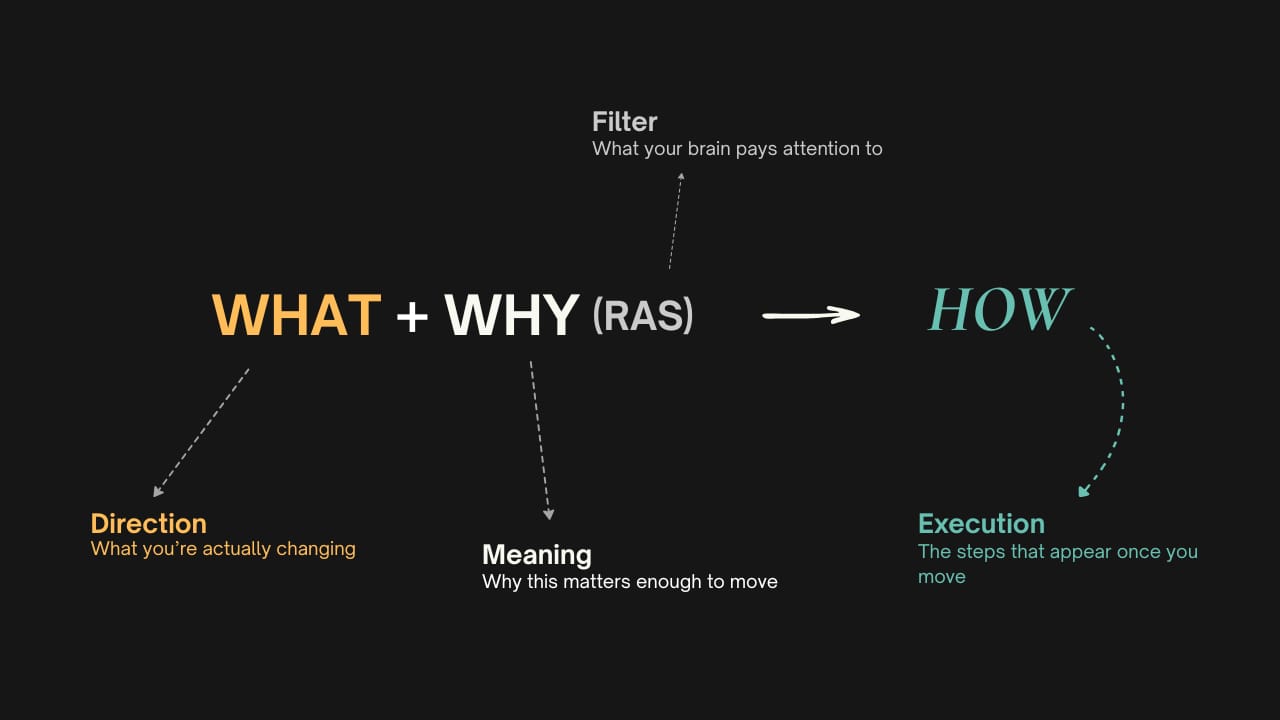
RAS explained in the following section
First, get brutally clear on what you want to change. Not vaguely. Not philosophically. Something real enough that not acting on it creates friction.
Then attach a why that actually has weight. Meaning. Something that makes inaction uncomfortable. Something that forces you to stop negotiating with yourself.
Only then does how become relevant. Because once you start moving, the question changes. It’s no longer “How do I make this work perfectly?” It becomes “What’s the next constraint in front of me?”
The how almost never unfolds the way you plan it. And the funny thing is, it usually unfolds better.
Faster. Stranger. More efficiently than anything you could have designed from the outside.
Every time you act, you collapse uncertainty. You replace speculation with feedback. You learn in days what planning couldn’t teach you in months.
This is why things start to accelerate after you move. Not before.
The more aligned action you take, the more unexpected leverage appears:
People.
Opportunities.
Shortcuts
None of them show up in planning. All of them show up in motion.
It feels nonlinear because it is. And it’s not magic, it’s neuroscience.
What’s Happening Under the Hood
Your brain has a filtering system. A powerful one.
At any given moment, there is far more information available than you could ever consciously process. Sounds, ideas, opportunities, risks, conversations, signals. Most of it never reaches awareness.
That filter is called the reticular activating system, or RAS. and its job is simple: Decide what matters. Let that through. Ignore everything else.
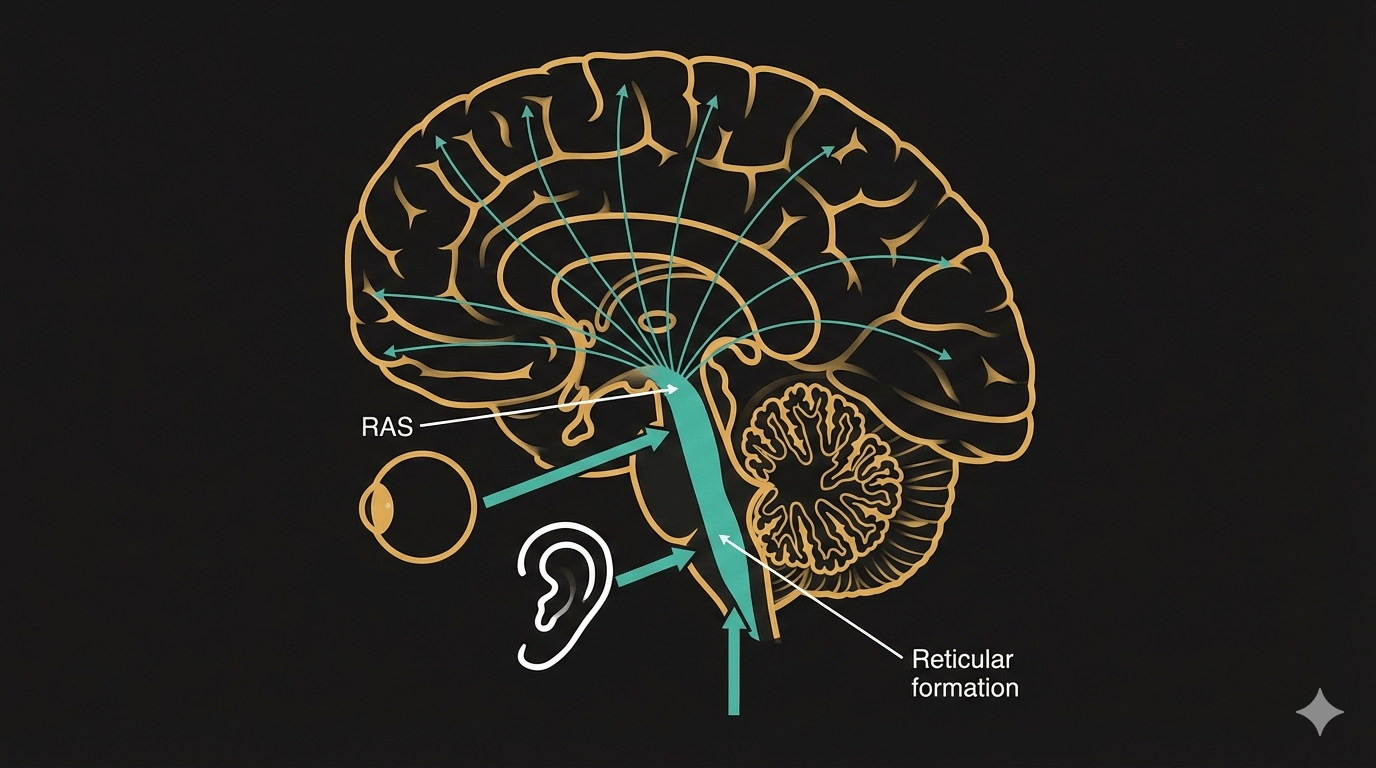
This filter is always running. And it is always neutral. It does not work for or against you by default; it works based on inputs.
Here’s the critical point: The RAS does not prioritize information based on curiosity, interest, or vague intention. It prioritizes based on direction. When direction is unclear, the filter stays wide. Everything competes for attention. Doubt, options, second-guessing, distractions. You feel scattered, overwhelmed, and unsure because your brain has no hierarchy.
When direction becomes clear, the filter tightens.
Information that supports that direction gets amplified. Irrelevant signals get suppressed. What felt confusing starts to feel obvious. Not because reality changed, but because the filter did.
This is why planning without direction feels exhausting. You’re forcing your brain to evaluate everything at once, with no criteria for relevance. This is also why action changes perception faster than thinking ever could.
Movement supplies data → Data sharpens direction → Direction sharpens the filter.
Once that happens, the question “how” stops being abstract, and becomes tactical and context-specific. The next step reveals itself through contrast: What works versus what doesn’t.
From the outside, this looks like luck. Or momentum. Or things “just falling into place.”
From the inside, it’s much simpler: your brain is finally filtering reality in your favor. Because you stopped asking it to process everything at once.
That’s why starting with “how” keeps you stuck.
And why once the order is right, the how has a way of figuring itself out.